

Non-Surgical Facelift: Comparing Dermal Fillers, Thread Lift, RF, and HIFU
Facial sagging, volume loss, deeper folds, and a less defined jawline are common signs of aging. In the past, surgical facelift procedures were considered the main solution for these changes. Today, however, several minimally invasive and non-surgical treatments can improve facial contours and skin firmness without large incisions, general anesthesia, or a long recovery period.
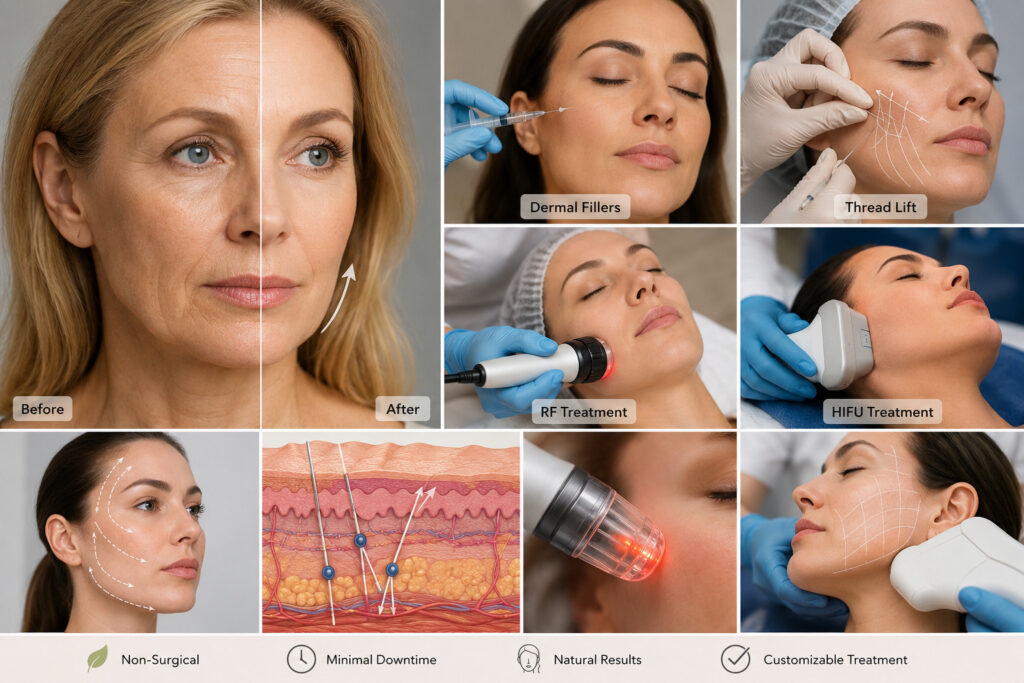
Dermal fillers, thread lifts, radiofrequency treatments, and HIFU are among the most popular options for a non-surgical facelift. However, these treatments do not work in the same way.
Dermal fillers are mainly used to restore lost facial volume and improve facial structure. Thread lifts can mechanically reposition mildly sagging tissues. Radiofrequency, also known as RF, uses controlled heat to stimulate collagen production and improve skin quality. HIFU uses focused ultrasound energy to target deeper layers of tissue and promote gradual skin tightening.
The best non-surgical facelift treatment depends on the main cause of facial aging, the severity of skin laxity, facial anatomy, skin quality, age, and the patient’s expectations.
In this article, we compare dermal fillers, thread lifts, RF, and HIFU in terms of how they work, their benefits, recovery time, limitations, and the type of patient for whom each treatment may be most suitable.
💎What Is a Non-Surgical Facelift?
A non-surgical facelift refers to a group of cosmetic treatments designed to improve facial sagging, volume loss, wrinkles, and skin firmness without traditional facelift surgery.
The term “non-surgical” does not necessarily mean that every treatment is completely non-invasive. HIFU and some types of RF are performed without needles or incisions. Dermal fillers and thread lifts, on the other hand, are considered minimally invasive because they involve injections, cannulas, or absorbable threads being placed beneath the skin.
The main goals of a non-surgical facelift may include:
- Improving mild to moderate facial sagging
- Restoring lost facial volume
- Defining the jawline
- Enhancing the shape of the chin and cheeks
- Softening deep facial folds
- Stimulating collagen production
- Improving skin firmness and texture
- Creating a younger appearance without dramatically changing facial features
It is important to understand that non-surgical treatments cannot always produce the same degree of lifting as facelift surgery. They are generally more suitable for patients with mild to moderate signs of aging who prefer natural-looking results and a shorter recovery period.
💎Why Does the Face Begin to Sag?
Facial aging is not caused only by loose skin. Several layers of the face change over time.
Collagen and elastin production gradually decreases, causing the skin to become thinner and less firm. Facial fat pads may shrink or move downward. Bone structure also changes with age, reducing support for the overlying soft tissues.
These changes may result in:
- Flattened or less prominent cheeks
- Deeper nasolabial folds
- Marionette lines around the mouth
- Lower-face sagging
- Reduced jawline definition
- Loose skin under the chin
- Hollow temples
- Under-eye hollows
- Reduced skin firmness and elasticity
Because facial aging has multiple causes, one treatment is not suitable for every patient. A person with significant cheek volume loss may benefit more from dermal fillers, while someone with adequate facial volume but mild skin laxity may be a better candidate for RF or HIFU.
1️⃣ Non-Surgical Facelift with Dermal Fillers
Dermal fillers are injectable substances used to restore volume, soften folds, improve facial proportions, and support facial tissues.
Many commonly used fillers are made from hyaluronic acid, a substance naturally found in the human body. Hyaluronic acid attracts and retains moisture, helping restore volume and improve facial contours.
Fillers do not literally tighten loose skin. Instead, they can reduce the appearance of sagging by replacing lost volume and creating structural support in carefully selected areas. This approach is sometimes called a liquid facelift.
Which Areas Can Be Treated with Fillers?
Depending on the patient’s facial anatomy, dermal fillers may be used in areas such as:
- Cheeks
- Temples
- Chin
- Jawline
- Nasolabial folds
- Marionette lines
- Under-eye hollows
- Areas affected by age-related volume loss
Strategic filler placement in the cheeks, chin, or jawline can improve facial balance and indirectly reduce the appearance of lower-face sagging.
Benefits of Dermal Fillers
- Results are visible relatively quickly
- Facial volume can be restored precisely
- Suitable for cheek, chin, and jawline contouring
- Usually involves a short recovery period
- Treatment can be customized to facial anatomy
- Certain hyaluronic acid fillers can be dissolved if necessary
- Useful for age-related volume loss
Limitations of Dermal Fillers
Fillers are not suitable for severe skin laxity. Injecting too much product may make the face appear heavy, swollen, or unnatural.
The goal should not simply be to fill every line. The doctor should assess facial proportions, bone structure, volume loss, skin quality, and facial symmetry before treatment.
Common temporary side effects may include:
- Swelling
- Bruising
- Redness
- Tenderness
- Temporary asymmetry
A rare but serious complication can occur if filler is accidentally injected into a blood vessel. This may cause tissue damage and, in extremely rare cases, visual complications. Therefore, dermal fillers should only be administered by a qualified medical professional with a detailed understanding of facial anatomy.
2️⃣ Non-Surgical Facelift with Threads
A thread lift uses special absorbable threads placed beneath the skin through small entry points. Some threads contain barbs or cones that attach to the tissue and allow the doctor to reposition mildly sagging areas.
Thread lifting may create results in two ways. First, it provides mechanical repositioning of the tissue. Second, the presence of the thread may stimulate a healing response and collagen production around the treated area.
Which Areas Can Be Treated with a Thread Lift?
A thread lift may be considered for:
- Mild cheek sagging
- Lower-face laxity
- Jawline definition
- Drooping eyebrows
- Mild neck laxity
- Marionette areas around the mouth
The degree of lifting depends on the thread type, treatment direction, skin thickness, tissue weight, and the practitioner’s technique.
Benefits of a Thread Lift
- Some lifting may be visible immediately
- May stimulate collagen production
- Shorter recovery than surgery
- No large incisions
- Suitable for some cases of mild to moderate sagging
- Can target specific facial areas
Limitations of a Thread Lift
A thread lift cannot provide the same degree of correction as surgical facelift surgery. Results may also be limited in patients with severe skin laxity, very thin skin, or heavy facial tissue.
Possible side effects and complications may include:
- Swelling
- Bruising
- Tenderness
- Temporary pulling sensations
- Skin dimpling
- Asymmetry
- Visible or palpable threads
- Infection
- Thread extrusion or migration
Careful patient selection is especially important. An unsuitable candidate may experience a limited or uneven result.
Who Is a Good Candidate for a Thread Lift?
A thread lift may be suitable for someone who:
- Has mild to moderate cheek or jawline sagging
- Wants more visible lifting than energy-based treatments may provide
- Does not want surgical facelift surgery
- Has skin capable of supporting the threads
- Understands that the result is not permanent
- Accepts the aftercare and temporary restrictions
3️⃣ Non-Surgical Facelift with Radiofrequency
Radiofrequency treatments use controlled RF energy to generate heat within targeted tissue layers. This heat may cause partial contraction of existing collagen fibers and stimulate the production of new collagen over time.
There are several types of RF treatment.
Non-invasive RF delivers energy through the surface of the skin. RF microneedling uses small needles to deliver radiofrequency energy at specific depths and is therefore considered minimally invasive.
What Can RF Improve?
Radiofrequency may help improve:
- Mild to moderate skin laxity
- Reduced facial firmness
- Fine lines
- Mild jawline sagging
- Uneven skin texture
- Some acne scars with RF microneedling
- Loss of elasticity
Benefits of RF
- Stimulates gradual collagen production
- Improves skin firmness and texture
- Can be used on the face and neck
- Minimal downtime with non-invasive devices
- Results usually appear natural and gradual
- Treatment depth and intensity can often be adjusted
Limitations of RF
RF does not usually create a dramatic or immediate facelift. Several weeks or months may be needed for collagen remodeling, and some treatment plans require multiple sessions.
Possible side effects may include:
- Temporary redness
- Mild swelling
- Warmth or sensitivity
- Temporary dryness
- Peeling after RF microneedling
Incorrect settings, excessive energy, or improper depth may increase the risk of burns, pigmentation changes, scarring, nerve injury, or unwanted fat loss.
RF microneedling should therefore be treated as a medical procedure and performed by a trained professional.
Who Is a Good Candidate for RF?
Radiofrequency may be suitable for patients who:
- Have mild to moderate skin laxity
- Want to improve skin quality and firmness
- Prefer gradual and natural-looking results
- Do not have major facial volume loss
- Do not want fillers or thread lifting
- Want to improve both texture and tightness
4️⃣ Non-Surgical Facelift with HIFU
HIFU stands for High-Intensity Focused Ultrasound. It uses focused ultrasound energy to target specific depths beneath the skin.
The energy creates controlled thermal points within the tissue, which may stimulate collagen remodeling and gradual tightening.
Unlike surgery, HIFU does not involve incisions. Unlike dermal fillers, it does not add volume. Its main goal is to improve skin firmness and mild to moderate laxity.
Which Areas Can Be Treated with HIFU?
HIFU may be used for:
- Jawline definition
- Skin under the chin
- Neck laxity
- Mild cheek sagging
- Brow area
- Mild facial skin laxity
Benefits of HIFU
- No injections or surgical incisions
- Usually minimal downtime
- Stimulates collagen production
- Suitable for mild tightening of the face and neck
- Results appear gradually
- May improve jawline and under-chin definition
Limitations of HIFU
HIFU is not designed to replace facial volume, fill deep hollows, or directly correct major structural deficiencies.
Patients with thin faces or limited facial fat should be evaluated carefully. Excessive energy or inappropriate treatment depth may contribute to unwanted facial volume reduction.
Possible temporary side effects may include:
- Redness
- Swelling
- Tingling
- Tenderness
- Temporary numbness
- Discomfort during treatment
Serious complications such as burns or nerve injury are uncommon but may occur when unsuitable devices or incorrect techniques are used.
💎Who Is a Good Candidate for HIFU?
HIFU may be suitable for a patient who:
- Has mild to moderate skin laxity
- Wants a non-invasive treatment
- Does not want injections or threads
- Can wait for gradual results
- Has sufficient facial volume
- Understands that the result will be less dramatic than surgery
💎Comparison of Dermal Fillers, Thread Lift, RF, and HIFU
| Feature | Dermal Fillers | Thread Lift | RF | HIFU |
|---|---|---|---|---|
| Main function | Restores volume and improves facial structure | Mechanically repositions tissue and stimulates collagen | Uses controlled heat to stimulate collagen | Uses focused ultrasound energy to stimulate collagen |
| Best for | Volume loss, cheeks, chin, and jawline | Mild to moderate sagging | Mild laxity and reduced skin quality | Mild to moderate laxity of the face and neck |
| When results appear | Most results appear quickly | Some results are immediate | Results appear gradually | Results appear gradually |
| Invasiveness | Minimally invasive | Minimally invasive | Non-invasive or minimally invasive | Non-invasive |
| Recovery time | Usually short | Usually a few days of restrictions | Minimal with non-invasive RF; longer with microneedling RF | Usually minimal |
| Restores lost volume | Yes | No | No | No |
| Provides mechanical lifting | Indirectly | Yes | Limited and gradual | Limited and gradual |
| Multiple sessions | Depends on the treatment plan | Depends on individual assessment | Often required | Depends on the device and patient |
| Degree of result | Depends on placement and volume | Moderate and less than surgery | Mild to moderate | Mild to moderate |
| Main limitation | Risk of overfilling or vascular complications | Dimpling, asymmetry, or palpable threads | Risk of burns or tissue injury with incorrect settings | Limited effect in severe laxity |
💎Which Is Better: Fillers, Threads, RF, or HIFU?
There is no single best treatment for every patient. The correct choice depends on the main facial concern.
If the Face Has Lost Volume
Dermal fillers are usually more suitable because RF, HIFU, and thread lifts cannot replace lost volume in the cheeks, temples, chin, or other hollow areas.
If There Is Localized Sagging
A thread lift may provide more visible tissue repositioning than some energy-based treatments, particularly when the sagging is mild or moderate.
If the Main Problem Is Skin Quality
RF may be a suitable option when the main goals are to improve skin firmness, texture, and collagen production.
If the Patient Wants a Completely Non-Invasive Option
HIFU may be considered for mild to moderate laxity, especially around the jawline, chin, and neck.
💎Can These Treatments Be Combined?
Many patients have more than one sign of facial aging. For example, a patient may have cheek volume loss, mild jawline sagging, and reduced skin firmness at the same time.
In these situations, a combined treatment plan may be more effective.
A doctor may recommend:
- Dermal fillers to restore lost volume
- RF to improve skin texture and firmness
- HIFU to tighten selected areas
- Threads to reposition specific sagging tissues
However, combining treatments does not mean that all procedures should be performed at the same time.
The order of treatment, interval between procedures, treatment areas, device settings, and filler placement must be carefully planned. Performing several treatments too close together may increase swelling, inflammation, or tissue damage.
A staged treatment plan is usually safer and more predictable.
💎Who Is a Good Candidate for a Non-Surgical Facelift?
A suitable candidate generally:
- Has mild to moderate facial sagging
- Wants a natural-looking improvement
- Understands that results are less dramatic than surgery
- Is in generally good health
- Does not have an active infection in the treatment area
- Has realistic expectations
- Can follow pre-treatment and post-treatment instructions
- Accepts that maintenance treatments may be needed
💎Who May Need Surgical Facelift Surgery?
Non-surgical treatments may provide limited results when a patient has:
- Severe skin laxity
- Significant excess skin
- Heavy lower-face sagging
- Pronounced neck bands
- Major jowls
- A desire for a dramatic and long-lasting result
- A need for removal of excess skin
In these situations, consultation with a qualified plastic surgeon may be more appropriate.
💎General Aftercare Instructions
Aftercare varies depending on the procedure, but general recommendations may include:
- Avoid pressing or massaging the treated area unless instructed
- Avoid strenuous exercise for the recommended period
- Avoid saunas, steam rooms, and excessive heat
- Do not use irritating skincare products until approved
- Follow all medication and skincare instructions
- Protect the skin from direct sun exposure
- Attend follow-up appointments
- Contact the clinic immediately if unusual symptoms occur
Seek urgent medical attention after dermal filler treatment if you experience severe pain, skin discoloration, visual disturbances, or rapidly worsening swelling.
💎How Is the Best Treatment Selected?
The best non-surgical facelift treatment should be selected after a full facial assessment.
The doctor may evaluate:
- The amount and location of volume loss
- The severity of skin laxity
- Skin thickness and quality
- Facial fat distribution
- Bone structure
- Facial symmetry
- Previous cosmetic treatments
- Medical conditions
- Current medications
- Desired results
- Willingness to accept downtime
- Ability to maintain results
The most effective treatment is not always the most aggressive one. A carefully planned and limited correction may create a more natural result than excessive filler or unnecessary combination treatments.
💎Conclusion
Dermal fillers, thread lifts, RF, and HIFU can all contribute to facial rejuvenation, but each treatment addresses a different aspect of facial aging.
Dermal fillers are most effective for restoring volume and improving facial proportions. Thread lifts may provide limited mechanical lifting in selected patients. RF mainly improves skin firmness and texture by stimulating collagen. HIFU targets deeper tissue layers with focused ultrasound and may help tighten mildly sagging skin.
No single treatment is best for everyone.
The most appropriate option depends on whether the main concern is volume loss, loose skin, poor skin quality, or localized tissue sagging. A professional facial assessment is essential before choosing a treatment.
The quality of the device, the type of injectable product, the practitioner’s experience, sterile technique, and proper aftercare all have a major impact on treatment safety and results.
Frequently Asked Questions
❓Which non-surgical facelift treatment gives the fastest result?
Dermal fillers usually create the fastest visible change because they immediately restore volume. A thread lift may also create an immediate lifting effect. RF and HIFU results generally develop gradually as collagen production increases.
❓Is filler or HIFU better for jawline definition?
If the jawline lacks structure because of a weak chin or volume deficiency, filler may be more suitable. If the main problem is mild loose skin around the jawline, HIFU or RF may be considered.
❓Is a thread lift better than HIFU?
A thread lift may mechanically reposition tissue, while HIFU stimulates gradual skin tightening without inserting anything beneath the skin. The better option depends on the amount of sagging, skin quality, facial structure, and patient expectations.
❓Can RF make the face look thinner?
RF is generally used to improve skin firmness. However, inappropriate energy levels or treatment depth may cause unwanted fat reduction in some patients. Treatment settings should be adjusted according to facial anatomy.
❓Is HIFU suitable for a thin face?
Patients with very thin faces or limited facial fat require careful evaluation. Excessive treatment or incorrect depth may contribute to unwanted volume loss.
❓How long do non-surgical facelift results last?
Longevity varies according to the treatment, product, device, age, skin condition, lifestyle, metabolism, and maintenance plan. No treatment lasts the same amount of time in every patient.
❓Can a non-surgical facelift completely replace surgery?
Non-surgical treatments may improve mild to moderate signs of aging, but they usually cannot replace surgery in cases of severe sagging or significant excess skin.
https://shorturl.fm/YXd57
https://shorturl.fm/rEfeZ
https://shorturl.fm/Ybwsk
https://shorturl.fm/zHSj8
https://shorturl.fm/bdqYR
https://shorturl.fm/HxDgS
https://shorturl.fm/PVIPW
https://shorturl.fm/eiWIK
https://shorturl.fm/jYYic
https://shorturl.fm/pcfZw
https://shorturl.fm/weubh
https://shorturl.fm/VA4TW
https://shorturl.fm/yAKg4
https://shorturl.fm/Q3TD6
https://shorturl.fm/hnLr5
https://shorturl.fm/DiIrk
Cảm ơn bài viết. Với dịch vụ du học Hàn Quốc chuyên nghiệp, Letco giúp bạn tiết kiệm thời gian và chi phí chuẩn bị hồ sơ. Truy cập letco.vn để biết thêm.
Great post,Thanks for sharing
[216820]supplies professional anti-violence equipments and solutions for the whole world with strong and perfect production capacity. anti-violence.org
Bookmarking this for later! I’ve just been using a careers platform at https://efph.nicedealshub.com/ that honestly changed how I look for work. You can filter by location, employer and salary, and the listings stay current. Hope that helps someone here.
[516664]supplies professional anti-violence equipments and solutions for the whole world with strong and perfect production capacity. anti-violence.org
I really like the variety of options available here. There is always something new to try out and the graphics are quite impressive. idseven77
The slots here are incredibly fair and the graphics are stunning. It is a lot of fun and very addictive in a good way. Definitely check out angkarajaslot.
Fast loads and no annoying glitches. This is exactly how a gaming site should operate. I am very happy with kr333win
The app is way more convenient than the browser version. Everything is just a tap away and the graphics are crisp. Get see789apk now.
Appreciate the details here. Came across occupationworks.shop recently and it lines up well with this.
Hi~(* ̄▽ ̄*)
[9517]tx388 Login Chính Thức | Tải App APK và Cách Chơi Tài Xỉu,tx388 cung cấp hướng dẫn nạp tiền casino nhanh và luật chơi baccarat online chi tiết cho người mới. Truy cập ngay để trải nghiệm sảnh game uy tín và chuyên nghiệp. visit: tx388
Finally found a link that actually works without any glitches. The login process is seamless. Cheers to brazino777login for the great service.
I’ve tried a few sites lately, but the experience here is just smoother. The payouts are fast and the games are super addictive. Definitely checking out senja128slot again tonight!
If you are looking for a real solution to win more often, this is the place. The tips and the platform are top notch. idsolusiwin is a hidden gem.
[9635]evotaya Official Login | Online Slots PH with GCash Payments,evotaya offers a premium gaming experience. Download the app to access top online slots and learn winning baccarat strategies. Join now for fast GCash payouts. visit: evotaya
Finally found a site that actually treats players right. Great variety of options and the customer support is top notch. Highly recommend idayam11
[8236]Spinara Official Login | সেরা অনলাইন ক্যাসিনো ও দ্রুত বিকাশ পেমেন্ট,spinara অ্যাপ ডাউনলোড করে সেরা অনলাইন ক্যাসিনো গেমসের অভিজ্ঞতা নিন। এখানে পাবেন দ্রুত বিকাশ পেমেন্ট এবং সহজ স্লট গেম খেলার নিয়ম। আজই জয়েন করুন। visit: spinara
Super fast loading times and the graphics are top notch. It feels like a real casino right on my phone. Give ph998jili a go!
[1046]cap777 Login Oficial | Slots Online y Depósitos en Oxxo,Accede a cap777 para disfrutar de las mejores slots online. Descarga la app oficial y recarga tu cuenta fácilmente en Oxxo. ¡Regístrate y comienza a jugar ahora! visit: cap777
The login process is quick and hassle free. I love how they keep updating the platform to make it more user friendly. Love bt777login
[8096]hdbet | Link vào trang chủ và hướng dẫn tải app chính thức,Truy cập hdbet để trải nghiệm sòng bài trực tuyến, tìm hiểu cách chơi baccarat online và mẹo quay slot nổ hũ dễ thắng. Đăng ký tài khoản và tham gia ngay. visit: hdbet
Fast payouts and a huge selection of games. I managed to hit a decent streak last night. If you are looking for a reliable site, mpocashslot is the way to go.
The site is very responsive and the updates are frequent. It feels like they actually care about the user experience. Definitely check out br939bet46 if you want a reliable spot.
Finally found a site where the login process is actually fast and doesn’t glitch. Had a great run last night with some big wins. Highly recommend jilijililogin to everyone.
[6304]Winjili Official Login | Best GCash Online Slots Philippines,Winjili offers a secure platform for online slots Philippines. Get the app download for easy access and learn how to play baccarat. Join the action today! visit: winjili
[6413]Pillo Login Oficial | Slots en Vivo y Depósitos SPEI,Accede a pillo para disfrutar las mejores slots en vivo. Descarga la apk oficial, aprende cómo jugar ruleta online y gestiona tu cuenta fácilmente. ¡Regístrate ya! visit: pillo
The variety of games here is impressive. I spend hours exploring different slots and they all work flawlessly. Big thanks to vnbancanohu
Top notch entertainment and very fair odds. I’ve tried many sites but this one stands out the most in terms of quality. Go to pkca777 now.
Accessing my favorite games has never been this effortless. The login process is incredibly secure yet completely stress free. I love how the system stays stable even during peak hours without any annoying lag or pop ups. My deposits and wins are always visible in one clean place. This is exactly how an online platform should feel. vblinkbackendlogin
The best platform I have encountered in the region. Very user friendly and the promotions are actually useful for players. Big thanks to ph39jiliph.
Best gaming experience I’ve had in a while. The graphics are crisp and the payouts are legit. Give phroyalbet a try!
Honestly, it’s really good
Honestly the best experience I have had in a long time. The rewards are fair and the gameplay is super addictive. Big fan of idminion178
So,I like it
Finally found a working link for the APK. Installation was a breeze and the app runs perfectly on my Android phone. Great job on the optimization! jjwingamedownloadapk
[5437]vip333 | Login Resmi Link Alternatif Slot Gacor Hari Ini,vip333 menyediakan link alternatif terbaru untuk daftar situs casino online dengan kemudahan deposit via dana. Nikmati pengalaman bermain terbaik dan daftar sekarang. visit: vip333
Finally a reliable way to get into the action here in Mexico. The odds are competitive and the registration process was a breeze. Give draftkingsmexico a try!
Quick deposits and even quicker withdrawals. It’s hard to find a reliable site like phjili31 these days.
https://addlinks.pro/SG3oA
I like this
Solid platform with a lot of exciting options. I really appreciate the transparency in their terms. Give phkavbet a go
I love the daily bonuses they offer. It keeps things exciting even when I am just playing for fun. Big thanks to 56bbet for the great vibes
[5166]Beteum লগইন এবং অ্যাপ ডাউনলোড – বিকাশ ক্যাসিনো ও স্লট গেম,beteum লগইন করুন এবং সেরা অনলাইন স্লট গেম উপভোগ করুন। বিকাশ দিয়ে ক্যাসিনো গেম খেলার সহজ উপায় ও অ্যাপ ডাউনলোড করতে আজই ভিজিট করুন। visit: beteum
https://addlinks.pro/KPy6E
Honestly the best experience I have had with a slot site recently. The payouts are fair and the interface is super smooth. Definitely check out jili988casinologin if you want a reliable place to play.
Such a friendly community and a great selection of games. I spend a few hours here every weekend and it never gets boring. Love vnzl88.
An Engaging Blog Post
[1865]Slingo লগইন এবং অ্যাপ ডাউনলোড | বিকাশ অনলাইন ক্যাসিনো গেম,Slingo লগইন করুন এবং সেরা অনলাইন স্লট গেম উপভোগ করুন। বিকাশ দিয়ে অনলাইন ক্যাসিনো পেমেন্ট ও অ্যাপ ডাউনলোড করে আজই খেলা শুরু করুন। visit: slingo
The app version is just so much better than the browser. Everything is snappy and the graphics are crisp. I’m spending way too much time on 555tayaapp lately!
https://addlinks.pro/0kPhs
https://addlinks.pro/KTA0B
WOW,Very wonderful
[9954]Heyvip · বাংলাদেশি খেলোয়াড়দের জন্য অনলাইন ক্যাসিনো এবং বেটিং গেমস · লগইন,Heyvip বাংলাদেশের অনলাইন ক্যাসিনো গেম খেলার একটি মাধ্যম যেখানে আপনি অ্যাকাউন্ট খুলে রেজিস্ট্রেশন এবং লগইন করতে পারেন, অ্যাপ ডাউনলোড করে ক্যাসিনো গেম খেলতে পারেন এবং পেমেন্ট সংক্রান্ত তথ্য পড়তে পারেন। visit: heyvip
[3884]jl58 Login Ph | Madaling Panalo na Slots at GCash Casino,Gamitin ang jl58 login ph para sa pinaka madaling slots panalo. Maaari ring mag-download APK at mag-casino gamit ang GCash. Mag-register na at maglaro! visit: jl58
https://addlinks.pro/5eYh4
The game variety here is amazing. I love how easy it is to navigate the site. Definitely give phjili333com a go.
Finally found a site where the bonuses actually feel fair. Had a great run on the slots last night! Definitely checking out ug234slot again this weekend.
I AM BACK AGAIN
The content is really great